
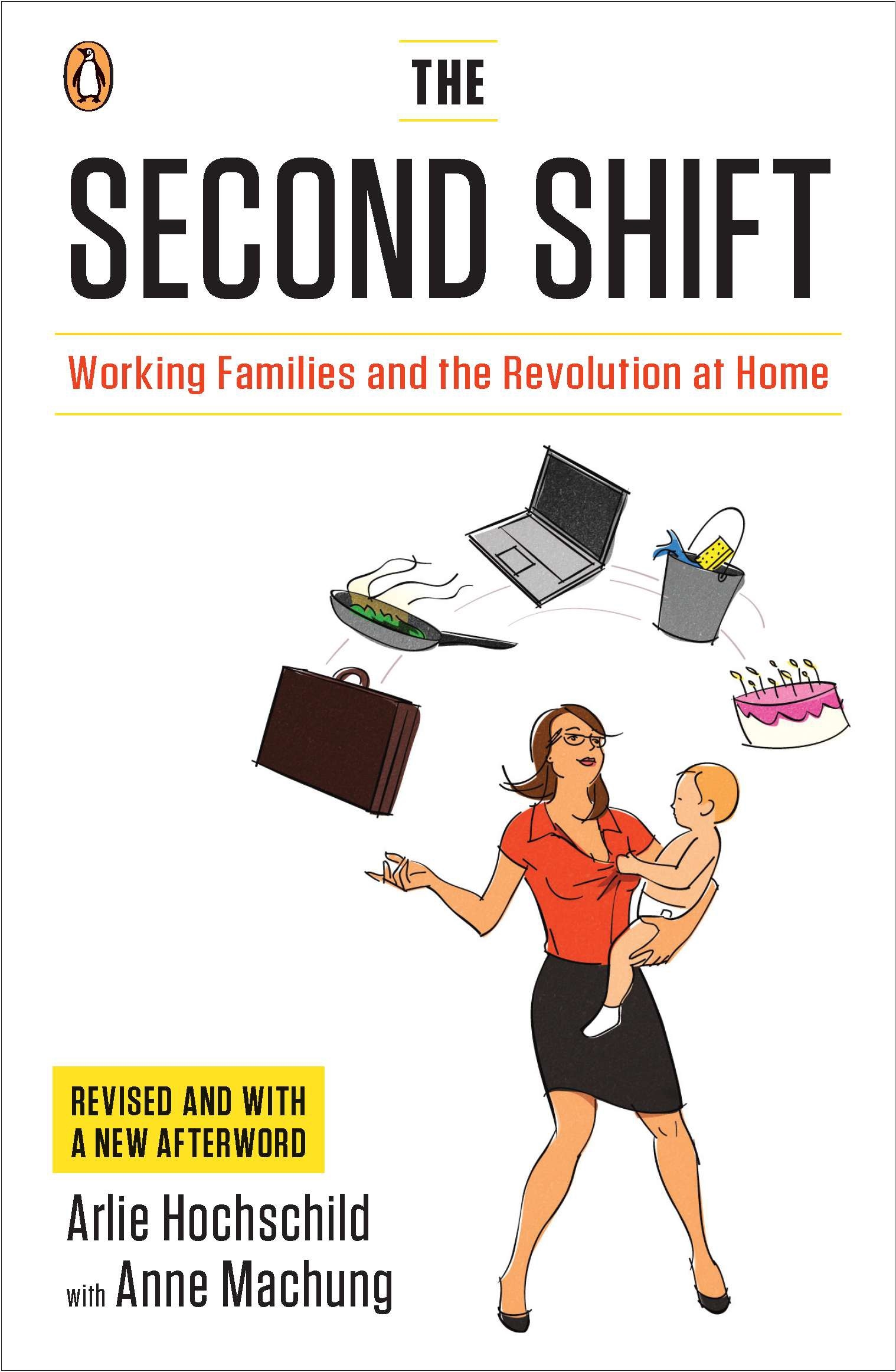
In The Second Shift: Working Families and the Revolution at Home, Arlie Hochschild (with Anne Machung) investigates how dual-earner couples manage the collision between changing gender expectations and inflexible economic realities. Examining the daily negotiations of contemporary households, Hochschild demonstrates that when both parents work full-time jobs, the family doesn’t simply adopt a busy routine; it enters what she terms an unrelenting “speed-up.” The hours in an ordinary day haven’t expanded since the era when most wives stayed home, but the labor required to sustain a family has doubled. Drawing on decades of national time-use surveys alongside her own detailed field observations, Hochschild shows that employed mothers put in roughly fifteen hours a week more than their husbands on combined job and home duties. Over a single year, that invisible accumulation amounts to an extra month of twenty-four-hour days; over a dozen years, it amounts to an entire extra year of around-the-clock labor.
The result inside the home is a sharp, everyday “leisure gap.” Working wives come through the door only to begin a second shift of cooking, laundry, and childcare, while husbands regularly enjoy long stretches of downtime, sleeping an extra half hour each night and watching significantly more television. The strain goes beyond raw minutes: it is built into the rigid, uncompromising nature of the chores women inherit. Mothers take on the fixed daily maintenance—getting dinner ready at six o’clock sharp, bathing toddlers, packing school lunches—routines that pin them to an unforgiving schedule. Fathers, meanwhile, tend to handle delayable, intermittent jobs like mowing the lawn, changing the car’s oil, or repairing an appliance, work that can wait until the weekend or at any convenient time. When fathers do pitch in with their children, they are far more likely to take them out for fun weekend outings to the park or movies, leaving mothers to run the daily grind of discipline, bedtimes, and rushed morning exits. Women become the house drill sergeants, managing the family clockwork while absorbing the exhaustion of a double day.
This disproportion stems directly from what Hochschild calls a “stalled revolution.” Over the latter half of the twentieth century, economic movements pushed millions of women into the paid workforce, yet the institutions around them barely budged. Workplaces still demand long, inflexible hours as though every employee has a traditional homemaker waiting at home, while public policies offer little reliable, affordable care. Meanwhile, male cultural attitudes have shifted far more slowly than women’s daily routines. Individual marriages end up functioning as the shock absorbers for this social gridlock, forced to privately negotiate a conflict that is fundamentally economic and political.
How couples manage that strain comes down to their personal “gender strategies”—the daily compromises and behavioral habits formed by their ingrained beliefs about manhood and womanhood. While very few people fit neatly into rigid categories, most fall along a spectrum between traditional, transitional, and egalitarian views. Pure traditionalists still believe home and work should be separate male and female domains, while egalitarians want both partners to share breadwinning and domestic labor evenly. Most couples, however, find themselves stuck in the messy transitional middle: a husband might take genuine pride in his wife’s career, yet still harbor an implicit conviction that the house and the children remain her primary responsibility.
Because spouses rarely share the exact same underlying beliefs, domestic battles are almost never just about sweeping floors or folding laundry. They stem from what Hochschild calls an “economy of gratitude.” In every marriage, both partners hold an internal sense of what counts as a routine duty versus an extraordinary gift. If a man feels his masculine identity relies on being the family’s primary earner, a wife’s larger paycheck won’t feel like a welcome boost; it will feel like a slight to his pride. In his mind, simply tolerating her higher income becomes his noble gift to her. The wife, struggling through a ten-hour workday only to face sinkfuls of dishes at night, sees no gift at all—she sees an unfair burden and an indifferent partner. When a couple no longer agrees on what deserves appreciation, even small daily chores turn into silent, bitter reckonings over respect and love.
To keep daily life manageable and avoid constant conflict, couples commonly rely on what Hochschild calls “family myths”—convenient, jointly held fictions that cover up deep inequalities so partners can protect their marriage and their self-esteem. A wider cultural cover-up props up these private fictions. Popular media during this era celebrated the glossy image of the tailored “supermom,” striding forward in a dark suit with a briefcase in one hand and a beaming toddler in the other. When Hochschild showed this picture to actual working mothers, they laughed out loud; one woman pointed out that the smiling lady in the ad obviously had a maid, while another joked that the woman was probably whistling so she couldn’t hear the commotion around her. The supermom myth is dangerous precisely because it recasts a societal crisis into a question of personal stamina. It celebrates the woman who can somehow manage a crushing double day entirely on her own, conveniently erasing the absence of corporate flexibility, public child care, and a helping husband.
Popular advice manuals and commercial culture step in to reinforce this compromise. Self-help books rarely tell women to demand that their husbands do half the dishes; instead, they tell working mothers to wake up early, make tighter lists, lower their housekeeping standards, or hire help that working-class families cannot possibly afford. In Having It All, Helen Gurley Brown breezily tells readers not to bang their heads against the stove when a husband refuses to cook or shop, crediting it to inevitable “household imbecility” that men make up for by loving their wives and paying bills. Where the culture doesn’t romanticize overwork, it treats it as a joke. Gift shops sell novelty mugs depicting frantic mothers with rumpled hair and mismatched shoes next to captions like “I am a working mother. I am nuts.” Meanwhile, the emergent cultural counter-image of the sensitive “new man” offers an equally misleading picture. It highlights proud fathers bonding with their children on weekend outings while glossing over the stubborn reality: workplaces still penalize men who step off the fast track to take on daily, unglamorous domestic maintenance.
The practical cost of these compromises comes alive in Nancy and Evan Holt’s marriage. Nancy, a dedicated social worker with a master’s degree, went into marriage committed to an egalitarian partnership. Her allegiance was driven by a disturbing warning tale: the memory of her own mother, who lived as a depressed housewife treated like a “doormat” by Nancy’s father. Evan, an affable warehouse furniture salesman, held a transitional outlook. He was proud of Nancy’s career, but he never signed up to overhaul his own routine. In Evan’s eyes, her demanding job was a personal choice that shouldn’t require him to sacrifice his evenings or take on thankless domestic chores.
Early on, Nancy tried setting up an alternating schedule where they would take turns cooking and doing laundry. Evan resisted without ever picking a direct fight. On his designated dinner nights, he routinely forgot key ingredients on his drive home, walked into an empty kitchen, and cheerfully suggested Chinese food. Laundry piled up on the living room couch as an unsolicited guest. When Nancy snapped, Evan dug in his heels, treating any chore chart as a rigid, nagging imposition on his freedom. The tension built until the couple encountered separation. Terrified by the financial struggle and solitude she saw among freshly divorced women around her, Nancy backed down. She chose a stable, unfair marriage over the risks of a broken one.
To keep the peace and save face, the Holts constructed one of the most remarkable family myths in Hochschild’s study: the “upstairs-downstairs” agreement. Nancy agreed to handle the upstairs—which happened to be the kitchen, dining room, living room, two bedrooms, and two bathrooms. Evan took charge of the downstairs, which consisted of the garage, his basement workshop, and the family dog. Both insisted, without irony, that this was a fair and equal fifty-fifty split. The myth protected Nancy’s self-image as a modern feminist and shielded Evan from feeling dominated, but the suppressed resentment found another outlet. Nancy grew exhausted and sexually unresponsive, treating sex as just one more chore, while four-year-old Joey developed severe bedtime problems. Joey refused to sleep before midnight, swatted at his father, and insisted on falling asleep in his parents’ bed. By monopolizing his mother’s remaining energy and crowding Evan out of the bedroom, Joey became the living expression of a marital struggle his parents refused to acknowledge.
If the Holts show what happens when a husband clings to domestic leisure, Peter and Nina Tanagawa reveal what happens when traditional career status gets flipped on its head. Nina, a brilliant and driven personnel manager at a computer firm, enjoyed a rapid rise into upper management, earning a salary that placed her in the top half of one percent of women nationwide. Her husband, Peter, ran a modest book-sales business. In simple economic terms, Nina’s extraordinary paycheck was a massive gift: it paid for a lovely home and private school tuition, and it gave Peter the financial freedom to consider retraining as a therapist.
Yet within a culture that equates manhood with breadwinning, Nina’s income seemed like a humiliating wound to Peter’s pride. The couple kept her salary a secret from their parents and friends to shield Peter from ridicule. More importantly, Peter psychologically restructured the marriage: his ability to endure the wounded ego of being outearned became his supreme gift to Nina. As he told Hochschild, only “one in a hundred men” could handle such an arrangement. Nina bought into this logic entirely, feeling intensely lucky that Peter stood by her, and she sought to repay her debt by quietly carrying seventy percent of the childcare and eighty percent of the housework. Peter was warm, loving, and attentive to family emotions, acting like an appreciative “nanny” or cheerleader, but he drew rigid limits around his masculine domain—passionately declaring that no woman in his house would ever mow the lawn.
This delicate bargain collapsed when their five-year-old daughter, Alexandra, began showing deep signs of distress. Alexandra had trouble making friends at school and eventually wrote a disturbing classroom story about hating her mother. Instead of treating this as a shared family dilemma, Peter and Nina each saw the trouble as a personal failure of Nina’s working motherhood. Peter encouraged her to do whatever she needed to do, but made no move to adjust his own work hours.
To rescue her daughter, Nina negotiated a pay cut to work three days a week. Her company—which publicly bragged about progressive family policies—retaliated immediately. Management labeled her uncommitted, stripped her of departments, revoked her bonuses, and moved her out of a large office overlooking the Bay into a dark, windowless cubicle. Male colleagues who had traditional stay-at-home wives sailed ahead on the fast track, while Nina was cast aside for daring to accommodate her family. Peter’s workday remained entirely undisturbed, leaving Nina to absorb the career hit and the emotional fallout alone.
Looking across her full sample of working families, Hochschild challenges the popular economic assumption that domestic labor simply tracks earning power. Conventional wisdom suggests that whoever makes more money or logs longer hours at the office automatically wins an exemption from cleaning the toilet or washing dishes. Yet her findings don’t support that. In reality, men who earned less than their wives or faced underemployment were frequently the most stubborn about avoiding the second shift. Deprived of the traditional male identity of primary breadwinner, these husbands treated domestic labor as a humiliating final defeat. Refusing to cook, sweep, or pack lunches became a desperate, defensive way to preserve their sense of manhood.
The minority of men who actively shared the second shift were moved by internal values rather than economic bargaining. These fathers embraced hands-on caretaking not as an occasional favor or woman’s work, but as a defining component of adult masculinity. In some instances, they were modeling themselves after involved fathers from their own childhoods; in others, they were consciously repudiating an emotionally distant parent. Just as often, sharing emerged because a wife drew an absolute line in the sand and refused to absorb the double day alone, forcing an honest renegotiation of household life before resentment took over the marriage.
To capture the divided existence of modern working women, Hochschild invokes the historical metaphor of the “urbanizing peasant.” Much like agrarian laborers in industrializing Europe who entered urban factories while remaining anchored to rural habits, working wives have stepped halfway into a modern capitalist economy. By day, they earn independent wages, negotiate contracts, and navigate professional hierarchies; by night, they return to homes governed by older, quasi-feudal expectations where domestic comfort is a woman’s natural duty. Husbands, meanwhile, enjoy the ease of modern double incomes while retaining the domestic privileges of a former era. The home ceases to be a shelter from the pressures of work; instead, it becomes a second workplace where the costs of a partially completed social transition are silently absorbed.
For my own research, Hochschild’s framework gives an important lens for examining how macro-level institutional arrangements shape micro-level negotiations of identity and labor. Her concepts of the “stalled revolution” and the “economy of gratitude” demonstrate that workplace demands and domestic expectations cannot be analyzed in isolation. Instead, individual workers constantly absorb the friction generated by institutions that demand complete professional dedication while taking caretaking for granted. Employing this system lets me examine how modern workers—particularly in high-demand, non-traditional, or performance-driven fields—manage the hidden emotional costs and informal compromises required to sustain both a public career and a viable private life.
Ultimately, Hochschild insists that private emotional gymnastics and fragile family myths cannot heal what is fundamentally a structural crisis. The strains pulling these marriages apart are public problems dumped into private homes. As long as employers design careers around an outdated template of the “ideal worker”—a person unencumbered by family responsibilities because a full-time homemaker operates in the background—working couples will remain caught in an exhausting bind. Unfreezing this stalled revolution requires an overhaul of both policy and culture: restructuring careers through real workplace flexibility and paid parental leave, establishing accessible child care, and dismantling the belief that domestic nurture is low-status, unpaid work. Until society recognizes daily caregiving as a fundamental human obligation rather than a woman’s secondary burden, millions of families will continue trying to survive modern lives inside obsolete social biographies.
As an Amazon Associate, I earn from qualifying purchases.