Jack Reacher Returns In Never Go Back

Lee Child and I at ThrillerFest VIII.

Lee Child and I at ThrillerFest VIII.

Lee Child’s 18th Jack Reacher novel, Never Go Back, is coming out next week in the U.S. For those interested in learning more about the book, below is the trailer and background on the novel from the man himself, Lee Child.


Book Review – The Informationist by Taylor Stevens

The InformationistI recently finished Taylor Stevens’ 2011 debut novel, The Informationist. It’s the first in a series of books featuring Vanessa “Michael” Munroe, an expert in uncovering information for her clients. She’s best described as a detective without a badge that’s not afraid to rough somebody up. Similar to Lee Child’s Jack Reacher novels, this book was about the main character and what she did to overcome seemingly insurmountable odds. It started off slow, and trudging my way through words that most people outside of Africa wouldn’t know how to pronounce wasn’t fun. But once I cut past this and reached the half-way point, the story found its groove. As I neared the end I was eager to see how things would wrap up. It was filled with action, believable dialogue and a lead character I look forward to following on future adventures. If you’re seeking an enjoyable thriller, The Informationist is worth a read.

Below is the official synopsis and book trailer. And stay tuned for my interview with Taylor Stevens later this summer; it should be a good one.

Synopsis 

Vanessa “Michael” Munroe deals in information—expensive information—working for corporations, heads of state, private clients, and anyone else who can pay for her unique brand of expertise. Born to missionary parents in lawless central Africa, Munroe took up with an infamous gunrunner and his mercenary crew when she was just fourteen. As his protégé, she earned the respect of the jungle’s most dangerous men, cultivating her own reputation for years until something sent her running. After almost a decade building a new life and lucrative career from her home base in Dallas, she’s never looked back.

Until now.

A Texas oil billionaire has hired her to find his daughter who vanished in Africa four years ago. It’s not her usual line of work, but she can’t resist the challenge. Pulled deep into the mystery of the missing girl, Munroe finds herself back in the lands of her childhood, betrayed, cut off from civilization, and left for dead. If she has any hope of escaping the jungle and the demons that drive her, she must come face-to-face with the past that she’s tried for so long to forget.

A Conversation With Dick Hill

Dick Hill HeadshotOver the past year I’ve become obsessed with audiobooks. They’re a great way for someone with a busy schedule (i.e., me) to enjoy books on the go. Whether I’m walking around town or brushing my teeth, I’m almost always listening to an audiobook on my iPhone or Kindle Fire HD, through the Audible or Overdrive apps.

Audiobooks are a magical form of entertainment because of the narrators that read them. These men and women are legitimate actors that breath life into the stories they read with a variety of intricate character voices, accents and dialects. The right audiobook narrator can make a mediocre book good and a great book excellent.

One of my favorite audiobook narrators is Dick Hill. Most famous for being the voice of Lee Child’s Jack Reacher series, Hill has nearly 500 audiobooks on Audible – including classics, sci-fi and fantasy, mysteries and thrillers, you name it. Hill is one of the most prolific audiobook narrators in the business and his ability to turn words into theater for the ears is impressive.

I recently had the honor of interviewing Dick Hill, and I hope the questions and answers below provide you with a greater understanding of this interesting profession. Enjoy!

How did you get involved in narrating books?

A friend of mine, Brit actor, was narrating for Brilliance Audio. They were looking to cast a WWII combat novel, and he suggested I get in touch. I did, recorded a couple pages of something similar I got off the supermarket shelf on a crappy little recorder and sent it to them. (They weren’t looking for audio quality, they’d provide that, they wanted to hear me read). Booked the gig, and knew I’d found my niche. Never looked back.

On average, how many hours does it take to record a book?

Depends on the length of the book, type of text etc. Generally I finish an hour of recorded book in around 75 minutes.

Do you read chapters straight through, or do you stop and start and edit the pieces together later to establish a seamless sound?

Susie is upstairs engineering and directing, and whenever I stumble or miss a word, we stop, roll back to a likely spot, then do a punch edit. She plays back for me to hear a lead in, then does an on the spot edit and I come right in and do it right. Generally.

How many audiobooks do you narrate each year?

I’d guess around 40 a year now, give or take a dozen.

From a business standpoint, do you have long-term contracts with publishers where you have to narrate a certain number of books a year, or are you hired on a book-by-book basis?

I’m paid per finished hour.

How are audiobook narrators compensated? Is there an upfront payment, a monthly retainer, royalties based on sales, or a combination of all three?

There are some works being done through ACX on royalty share, but I work strictly for fee. If Lee wanted to do a royalty share, or Stephen King, I’d be happy to, but those are not the kind of authors hoping to get someone to narrate their book on spec.

How do you make sure your recordings don’t include any background noise from inside the studio, like turning pages?

I’m quiet. I’ve developed a technique for moving from one page to the next that’s mostly soundless. If I do screw up, we just do an edit.

What is the most challenging aspect of your job and what is the most rewarding?

I find all the aspects I deal with challenging, but in a very good way. I relish the challenge of presenting the listener with the best, most compelling delivery I can achieve. It’s of the moment work, which I love doing. I don’t pre-read things, with a few exceptions. Susie preps the books, makes a vocabulary list to check, and gives me a character sheet noting gender, age, any accents mentioned or implied, etc. I use those to guide my performance. Since she’s prepped the book, she can alert me to any potential traps (e.g., don’t make the mystery caller too this or that) so the voice seems reasonable to fit the character it turns out to be. She generally doesn’t tell me just who those people are, or really, anything beyond performance guidance. I like to discover what happens right along with the listener. I love flying by the seat of my pants, doing cold reads. I’m good at them, and I think the sense of discovery helps with my work. Most rewarding?…pretty much all of it. Plus the checks. Getting paid to have fun, in large part.

Without naming it, have you ever had to narrate an awful book? If so, did you have to work harder or approach it differently than a book of higher quality?

Yes. Harder work. A couple were so bad I felt like a five dollar whore faking passion. I turned down any more work from those authors. Pretty lucky now, the publishers I work with most often have a very clear idea of the sort of things I like to do, and I’m seldom offered work I’d find offensive.

I’ve noticed that some of your books feature interesting audio effects to immerse the listener in the story. For example, Jack Reacher might be talking to someone on the phone and the voice on the other end is altered to sound as if it’s coming through a phone line. How is this done?

Those were probably earlier books. I prefer eschewing that sort of thing myself. If you’re gonna’ have a phone effect, then how about ambient noise, traffic, door slams, gunshots? I don’t include any effects or ask for any. I’m not aware of any publishers adding them any longer, though I’m not sure. I don’t listen to audiobooks myself, my own or anyone else’s. It’s immensely pleasurable to record books, but once I’ve done that why would I want to listen to them? Been there, done that.

What kind of personal preparation goes into getting to record an audiobook and how do you preserve your voice?

Occasionally if Susie gives me a heads up about a particular accent, I may go online to find samples of 15-year-old Malaysian girls with lisps raised in Irish Catholic orphanages till age ten then indentured as servants to a family of Germans with a Spanish head of the household. Other than that, I pretty much have a handle on how I approach accents, etc. Might not be Meryl Streepalicious, but then she has to perfect an accent for several hundred lines in a few projects per year. I do many more characters, many more books, so while I do try to do a good job with accents and dialects, my primary concern is to create characters and narrators that feel well motivated and interesting and further the author’s intent.

Recently, three of Lee Child’s Jack Reacher books, Die Trying, Tripwire and Running Blind, were rerecorded by another audiobook narrator, Jonathan McClain, and released on Audible. There was a backlash from fans for you not being the narrator. Do you know why your versions of these books were replaced and will you continue to be the voice of future Jack Reacher audiobooks, including Never Go Back, which comes out in the fall?

Yes, I’ve heard from a number of concerned folks. I think what that is, audio rights for the UK are issued separately, and Mr. McClain has been doing those. I will be doing the latest Reacher, and unless something happens I expect to continue doing so. Folks just have to look carefully to ensure they’re getting the reader they prefer, I guess.

Aside from narrating books, what other kinds of acting have you done?

I’ve worked regionally in live theatre, onstage. No film, some commercial video, ads and the like.

You and your wife have extensive experience in the audiobook industry. How did you two meet, and have you had the opportunity to collaborate on a project?

We met when she played Guinevere and I played Arthur in a production of Camelot. In addition to our work onstage, once we entered the audio world I directed her several times, she’s engineered and directed me on lord knows how many projects, and we’ve recorded a number of dual reads, one of which won us both Audies, the audiobook equivalent of an Oscar or a Tony. Or a Westchester Kennel Club best in show I suppose.

What projects are you currently working on that fans should look out for in the months to come?

Expecting that Reacher script soon, think there’s a fall release. Doing the last of the Stephen White series about Dr. Alan Gregory, which is heartbreaking for us. Love his writing and character insight, and one supporting character, Det. Sam Purdy, is one of the characters nearest and dearest to my heart. Susie’s prepping it this week, and is raving about how good it is and wailing about the fact that it is the last.

I’m Attending ThrillerFest!

ThrillerFestThis July I’m attending my first ThrillerFest, and I can’t wait! What is ThrillerFest, you ask? According to the website, it’s “a four-day celebration of thriller books, the authors who write them, and the fans who read them.” This year’s event features an endless list of bestselling authors, including Anne Rice, Michael Connelly, R.L. Stine, Lee Child, and, Andrew Gross, just to name a few.

The conference is broken into different parts. The first day-and-a-half is CraftFest, which is essentially a writing school featuring top authors, agents and editors. These individuals lead educational panels and workshops about almost any topic a writer could be interested in when it comes to writing fiction. Whether you’re looking to learn about blogging as a novelist or what point of view you should write from, CraftFest has you covered. Since I’m working on a novel of my own, I’m looking forward to soaking up all sorts of good information during CraftFest.

Starting Thursday afternoon (July 11), AgentFest begins, which is best described as speed dating for agents and authors looking for representation. While my novel is nowhere near being finished, I still look forward to observing these interactions and speaking with a few agents and authors about their experiences during this event.

Thursday night, once AgentFest has come to a close, the ThrillerFest opening reception takes place. Then the following two days (July 12 and 13) are filled with panels from bestselling authors about a variety of interesting subjects. Last year some of the topics covered included:

  • Writing Opposite Sex Characters
  • Is Indie Publishing For You?
  • How Do You Build A Thriller Brand?
  • What Makes Them Scream?
  • Is It Really That Hard To Be Funny?

I’ll also be attending the first-ever FanFest on Friday, July 12. It’s a two-hour portion of the conference where fans can drink and chat with a roomful of bestselling authors. I look forward to speaking with many authors whom I’ll be meeting for the first time, including Andrew Gross, who I recently interviewed for my blog.

ThrillerFest is bound to be a terrific experience that will yield fascinating stories, photos and advice. Stay tuned to my blog for extensive coverage of the event. It’s going to be something special.

Author Interview: Lisa Scottoline

rc2012033-NYT Lisa Scottoline

I recently had the honor of interviewing Lisa Scottoline, the author of the wonderful novel Don’t Goavailable April 9. As you’ll see below, her answers were a compelling and insightful look into the life of a bestselling author. I hope you enjoy the following Q&A.

Shakespeare said, “Brevity is the soul of wit” while Ray Bradbury felt, “Digression is the soul of wit.” When setting out to write engaging dialogue for your characters, what do you find works best?

What a great question! First, I never forget that the Shakespeare quote was in fact by Polonius, who is a bit of a fool, but he was definitely on the right track with his observation. I think I side with him more than Ray Bradbury, as great as Bradbury was. I say this because the governing principle of writing any novel, regardless of genre, is to get to the point. You really want to keep the reader engaged and turning the pages. That only happens if pace is paramount. Therefore nothing should be extraneous or extra. If you’ve made the point, you don’t need to make it again. Like I am now, in fact!

Some authors outline books ahead of time, like James Patterson, while others, like Lee Child, just sit down and write without planning ahead. How do you approach writing a story? Do you know exactly what’s going to happen and when, or do you let the characters lead the way?

I admire James Patterson, but I’m not as smart as he is, and I have much more in common with the wonderful Lee Child, in that I just sit down and write without planning ahead. I always say that not only do I not know how the book ends, I don’t even know how it middles. The great thing about writing is that there’s no correct answer and you get to do whatever works best for you. This works best for me because I like the spontaneity and excitement that not knowing what’s going to happen brings to me as a writer; I think if I planned it all out in advance in an outline, I would feel like the writing of it afterwards was like filling in the blanks, or playing Mad Libs. Also, the way I do it is unfortunately the kind of thing that leads to a constant state of anxiety, because I don’t know if I have a successful plot line at all, but part of me rationalizes even that. I think that being hyper-aware when you’re writing finds its way into the book and keeps the tension and excitement high, leading to that page-turner goal I always try to meet.

Ian Fleming wrote 2,000 words a day by sitting down at his desk and typing non-stop for hours at a time. Do you have a strict writing schedule to which you adhere?

This is amazing, because I never thought I had anything in common with the great Ian Fleming, but evidently I do. I actually sit down every day, 7 days a week, and meet a word count of 2000. I think that’s the perfect number because it takes the entire day and sometimes most of the night, but it seems to be about 9 pages and therefore enough to get out a single scene or plot element in a 1st draft. The good thing about having a word limit is not only does it enable you to get the words down the paper, which you absolutely must do in the end, but it also permits you a stopping point, in the event that you reach your 2000 word goal early. This happens to me a lot, and I like that very much. Mainly because, as anybody who works at home will tell you, it’s hard to turn work off when it’s just upstairs. If I meet my 2000 word goal at 7 o’clock, I can watch television or read without guilt, and that’s something to rejoice over.

Many bestselling authors have started to co-author books. You’ve collaborated with your daughter and contributed to The Chopin Manuscript and The Copper Bracelet. Would you ever consider working with another author on one of your novels?

I have cooperated and contributed to serial anthologies or chapter books for charitable reasons, like the ones you just mentioned, and I’m proud of my work in those things, but I never collaborated per se with another author in the actual writing of each sentence. I have already collaborated with my amazing daughter Francesca Serritella on the nonfiction humor books, but even there, she writes her own stories and I write mine, and we combine them in one volume. It’s hard for me to imagine a true joint production on something as personal and voice-laden as a novel, but I often think about writing a children’s book or something later with someone else. For that, we’ll have to stay tuned.

rc2012033-NYT Lisa ScottolineWhat did it mean to you when you won the Edgar Award in 1995 for Final Appeal

I was really honored to win the Edgar award because it’s given by the Mystery Writers of America, which is our oldest professional organization, and I was even lucky enough to be nominated for the award the year before that, though I didn’t win it. I actually think that loss was an equally important accomplishment, because the ultimate lesson in writing is to write the absolute best you can for yourself, and not for any extrinsic reward, whether it’s a wonderful award like the Edgar, or even a newspaper or blog review. I read all of those things and I care very much about them, but I don’t write for anyone else but me, and my assumption is always that if I think something is wonderful, my readers will too. They are my highest and best award ever.

Instead of the massive text and trite visuals most book covers are known for, your most recent novel covers have featured interactions between real people. Don’t Go has a beautiful orange glow to it and it features the book’s main character, Dr. Mike Scanlon and his daughter in a loving embrace. What led to this change in artistic direction a few years ago and what kind of feedback have you received from your fans?

Another excellent question! This is a completely accurate observation and I have a wonderful publisher in St. Martin’s and a great editor in Jennifer Enderlin, and we have together come up with these new covers, which I love. At the macro level, I’m writing 3 books years these days; two novels – one of which is a standalone and the other is the next installment of the Rosato & Associates series – and a humor memoir. Our little team wanted to figure out a way to differentiate these books, so that readers could easily see which was a standalone, which was a Rosato, and which was the nonfiction humor. I think the covers accurately capture that, and at the same time they share a common font and typeface which ties them all together, since they’re all books by me. In my heart, I believe that if you like one type of book by me, you’ll like the other type, because the voice always remains the same, and I work hard on that. But I’m aware that some people will read only Rosato and some people will read only the standalones, and so I feel really happy that we are always accurately representing my work and positioning it in a way in which it reaches the most number of readers.

Don’t Go focuses on the tumultuous life of a Doctor serving in the military. What was your inspiration for this novel?

There were so many inspirations for this book that is hard to pick just one, but the bottom line is that like any American citizen, I have been following with great absorption and concern the progress of our wars in Iraq and Afghanistan, and I am overwhelmingly grateful to the men and women who fight them on our behalf, as well as to the families and friends on the homefront, who make their own sacrifices, though not the ultimate sacrifice made by the soldiers. I’d also read a lot about the effects of wartime on custody arrangements in general, and this idea came to me and so I went with it. More and more I think the standalone novels, and even the ones that feature Rosato & Associates, as a blend of love story, family story, and crime story. I have educated myself on the development of the mystery and thriller genre in general, and I think this is a natural direction for it to take, because it’s not just a few writers that transcend genre but in fact, all of us are transcending genre these days.

rc2012033-NYT Lisa ScottolineDon’t Go is filled with interesting information about the day-to-day life of our armed forces overseas. Did you go into the book already aware of these details or did it require a great deal of additional research?

I did so much research for this book it’s not even funny. I don’t think I have ever spent so much time researching a novel except for Killer Smile, which as you may know, involves the internment of Italian-Americans during World War II. The research in Don’t Go was for much of the same reason, too; wartime is a grave and dramatic time in the history of a nation, if not globally, and attention must be paid to the details. Everything has to be right, because real lives are being sacrificed in real time. I interviewed an Army surgeon who served in Afghanistan and he read everything in the manuscript to make sure it was accurate, which I think is the best you can do when you’re writing about an Army surgeon who served in Afghanistan. It’s straight out of the horse’s mouth, so to speak. I also read widely and extensively on the subject, both fiction and nonfiction accounts of both wars, I listed all of those books in the Acknowledgements. While none of them gave me specific ideas, because that comes only from my head and heart, they certainly help form a backdrop that would help me get the details right.

Don’t Go is your 20th novel – a monumental accomplishment for any writer. Looking back, what’s your proudest professional accomplishment?

Aren’t you so nice to say so, and I am very proud of producing a really fine body of work over the past 20 years. I really want the name Scottoline to be synonymous with quality fiction, whether it’s humor, crime, love story, or family story. But of course, I have to tell you that my proudest accomplishment is raising a wonderful and amazing daughter in Francesca.

When I met you last year, at your book signing at Barnes & Noble on Rittenhouse Square, I was blown away by the fact that you remembered your fans’ first names upon seeing them. It was as if they were part of your extended family. After your first novel was published, how did it feel when people started to notice you and praise your work?

I do tend to remember people because I am such a people person, and of course my favorite people in the world are my fans, because they support me, both literally and figuratively. There is absolutely no feeling as good as walking into a room full of people who read a novel written by you and therefore know your heart, the way you think, the way you express yourself, the values you value as important, and all of the other things that any good novel contains, which is some amalgam of heart, brain, and human soul. I remember my readers because I love them. It’s as simple as that. And going to any signing is like a homecoming, even though we’ve never met. That is proof positive of the magic of fiction, because it brings people together at a soul level. And I feel so lucky to be a part of that partnership with my readers, forever.

And the interesting part about your question about when my 1st novel was published, how did it feel when people started to notice and praise my work, is that it doesn’t feel any different today than it did then. I still feel lucky and happy and surprised and blessed. I work very very hard, but I have a wonderful job, and I always endeavor to keep my side of my compact with the reader, which is to tell them a wonderful story, that even though it’s fiction, will contain an emotional truth that will resonate with them, and maybe help them deal with the ups and downs of their own lives, or maybe even encourage them through the tougher moments. Books do that for all of us, and I know it’s not only literally true, but that is a point worth making, because I get lots of e-mail from people who are actually convalescing or recovering from surgeries, were going through chemotherapy, or have just had a mastectomy, and all of them tell me that they managed to lose themselves in one of my mysteries or were laughing really hard at the humorous memoirs. Nothing can make me happier, and there is no greater purpose to fiction, or any form of writing, than to heal the human heart.

It’s All In The Details

I’m in the process of writing my first novel, and it’s a time-consuming endeavor because I work two jobs and I’m in graduate school. However, now that I have a new Google Chromebook, I’m starting to make some headway. Having just written a new chapter, I came to a realization about what makes a book memorable to readers – details.

Many of the most effective modern authors (e.g., Ken Follett, Lee Child, etc.) write stories that resonate with readers because they pay close attention to the details. By this I mean they take great care in making sure their stories are infused with a considerable amount of specificity. Whether it’s describing the color and texture of a piece of clothing or slowly unveiling a gripping backstory for one of the lead characters, these authors understand the value in creating a three-dimensional world that readers can practically smell, taste and touch.

With this in mind, I’m making sure my novel contains a considerable amount of detail. I want readers leave my book feeling like they have a true understanding of my characters, their motivations and where they come from. That said, I realize that it’s equally important to make sure the plot doesn’t play second fiddle to the details.

When reading a book or watching a movie or TV show, what do you enjoy most about the story? Do you find the details help flesh out the characters and the situations they face, or do you think they get in the way?

Movie Review: Jack Reacher

20121227-140251.jpg

Lee Child is one of my favorite authors, so when I heard a movie was coming out based on one of his books, One Shot, I knew I had to see it. The film is called Jack Reacher and it stars Tom Cruise in the lead role. As I mentioned in the past, many fans of the Jack Reacher novels doubted that Cruise could pull it off. However, I’m glad to report that he was exceptional in this role. Not only did I find myself believing that he was Jack Reacher, but Cruise was incredibly charming on screen too. The supporting cast did a fine job as well, especially Robert Duvall, who injected some humor into the serious plot.

Speaking of the plot, I have yet to read One Shot, so I can’t say how the film compares to the book. But I can say that it was an intriguing tale, even though certain “twists” were predictable. What made the film even more enjoyable was the cinematography and score; both were beautifully done and kept me engaged from start to finish.

Whether or not you’ve read Lee Child’s engrossing novels I highly recommend you see Jack Reacher. It’s an entertaining movie filled with action, humor and drama that is sure to please almost anyone.

Below you’ll find the official film synopsis and two clips.

Synopsis

Six shots. Five dead. One heartland city thrown into a state of terror. But within hours the cops have it solved: a slam-dunk case. Except for one thing. The accused man says: You got the wrong guy. Then he says: Get Reacher for me. And sure enough, ex-military investigator Jack Reacher is coming. He knows this shooter-a trained military sniper who never should have missed a shot. Reacher is certain something is not right-and soon the slam-dunk case explodes. Now Reacher is teamed with a beautiful young defense lawyer, moving closer to the unseen enemy who is pulling the strings. Reacher knows that no two opponents are created equal. This one has come to the heartland from his own kind of hell. And Reacher knows that the only way to take him down is to match his ruthlessness and cunning-and then beat him shot for shot.

Lee Child: On Writing & Jack Reacher

20121124-094911.jpg

At age 40 Lee Child wrote his first book: Killing Floor. It went on to win an Anthony Award for “Best First Novel” and kicked off the best-selling Jack Reacher series.

Below are two short-and-sweet interviews with Child. One is about writing and the other is about Reacher. Enjoy!

Jack Reacher: Theatrical Trailer

20121017-235925.jpg

Today, the full theatrical trailer was released for Jack Reacher starring Tom Cruise. I think it’s superior to the initial trailer because it provides additional plot details and gives the viewer a greater understanding of who Jack Reacher is and what motivates him. While Cruise may not physically resemble the Jack Reacher I envision when reading Lee Child’s captivating thrillers, I’m willing to give him the benefit of the doubt. After watching the trailer below, feel free to share your thoughts on whether or not you plan on seeing Jack Reacher.

Meeting Lee Child: The Man Behind Jack Reacher

Me (left) and Lee Child.

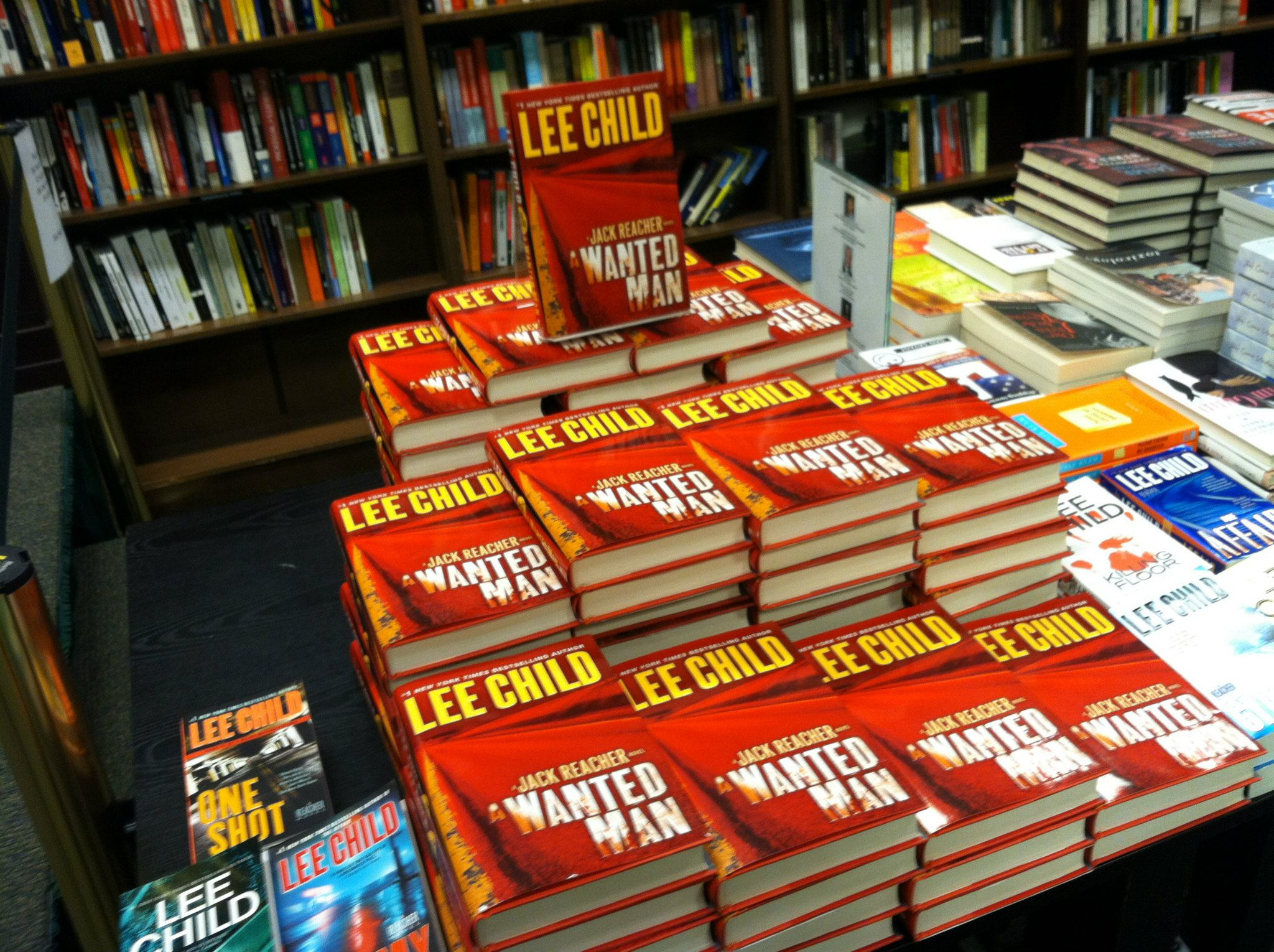
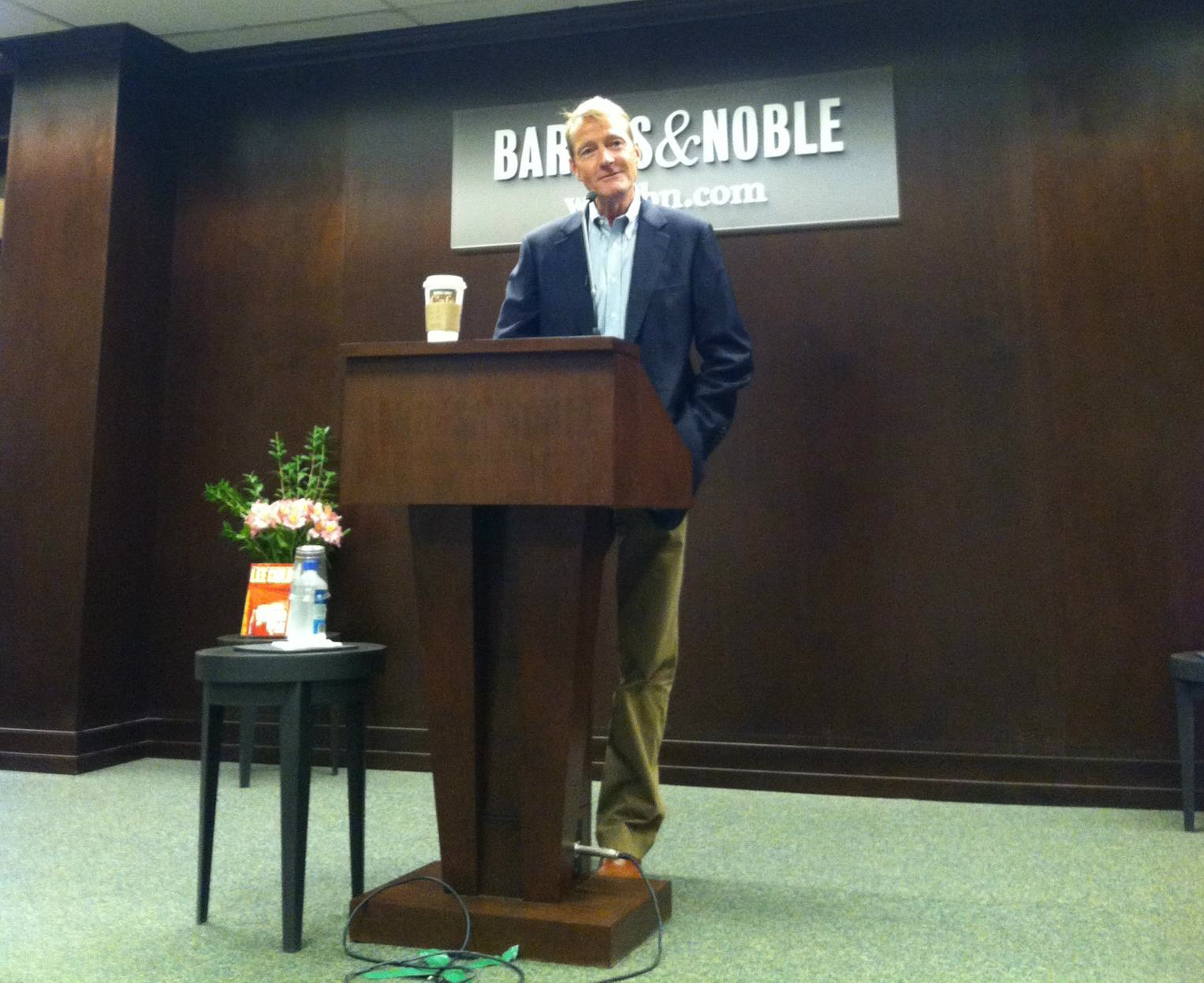
Yesterday, I went to New York City to meet Lee Child, author of the famous Jack Reacher novels. I took off from work and enjoyed a beautiful day in NYC before stopping by the Barnes & Noble where Child would be speaking and signing copies of A Wanted Man, his newest Reacher novel; the 17th in the series.

Upon my arrival, I bought a copy of Child’s new novel and went upstairs with the dinner I bought at Artie’s Delicatessen – you can’t go wrong with chicken fingers and french fries. Going into the event, I was a little nervous because, up to that point, I had only read three of the 17 books. And I didn’t want anything in the series spoiled by Child or the fans.

While I waited for Child to arrive, I listened to the last few chapters of Running Blind, the fourth novel in the series, and chatted with nearby fans. Before I knew it, it was 7 p.m. and Child was being introduced.

Decked out in khaki’s, an open-collar button down shirt, a blue blazer, and a beautiful pair of shoes, Child walked to the stage and was greeted with a warm round of applause from the room full of fans. The photos may not do him justice, but Child is 6-foot-5 and very slim. Not only that, but he’s a handsome man with an English accent, so, naturally, women adore him. During the Q&A portion, one woman asked, “Are you married?” To her dismay, he responded, “Yes.”

Child started off by telling us how he became an author. For nearly twenty years he worked for Granada Television in the UK, as a Presentation Director, where he wrote thousands of commercials, news stories and trailers. Then he said, “My boss told me something that prevented me from doing my job. He said, ‘you’re fired.'” This sudden unemployment, which came as a result of corporate restructuring, made Child write his first novel Killing Floor out of necessity. “I had to eat,” he told us. “And in the first 10 books, I made my former bosses the villains.”

According to Child, “60 percent of adults in the UK have never read an entire book.” They may have read magazines or parts of a book, but adults across the pond aren’t nearly as well read as Americans. Therefore, he made sure Jack Reacher and his first novel was targeted towards a U.S. audience. Clearly, it worked.

When it comes to writing he told us he never outlines a book. He has an idea and then starts writing. If he knew how the book was going to be laid out, from start to finish, he’d “get bored and not want to write it.” To him, writing should be like reading. “I’m just as excited to see what’s going to happen next as you are,” Child told the audience. “I give Reacher a problem and then make it worse,” he continued. His unique style involves introducing a variety of wild, but believable, situations in the first half of his books, and then in the second half, “I have to try and make sense of it. My plots might seem like a great deal of planning went into them, but that’s just an optical illusion. If you have an ink blot on a piece of paper, it looks like an amorphous mess. But if you hold a mirror up to it, it starts to look symmetrical.”

Child also talked about the controversial film, Jack Reacher, which is scheduled to come out in December. It’s been hotly debated by fans because Tom Cruise is playing Reacher. Since the character is 6-foot-5 and 250 pounds, this put off many Reacher Creatures. Child told the audience, “There aren’t any actors that are 6-foot-5 and 250 pounds. I was flown out to Hollywood to see this movie, and it’s spectacular. Trust me, Tom Cruise does a fantastic job. You’ll leave the theater feeling as if you’ve just witnessed Reacher moving and talking in real life.”

I adore the audiobook versions of the Jack Reacher novels, so I asked Child if he had heard them and if he chose Dick Hill to be the narrator because, to me, Hill is the voice of Reacher. Surprisingly, he told me that he doesn’t care for audiobooks because Child feels they keep to once pace, and he likes to vary how quickly or slowly he reads. However, he did say, “Dick Hill has brought a lot of fans to the series, and when I switched audiobook publishers I did it under one condition: they keep Dick Hill as the narrator.”

Another interesting thing he spoke about was the two recent, digital short stories he’s written in between Reacher novels. He said the publisher likes him to release these as a way to figure out which version of the upcoming novel people will be buying (i.e., digital or print). And it encourages people to pre-order his novels sooner than usual. However, Child is still undecided about whether or not he wants to continue writing them because fans get confused by their brevity and end up giving them bad reviews.

Overall, I had a wonderful time at the book signing. Child is a terrific author and a charming man. Since he lives in NYC, Child always has a book signing in the area. That said, I’ll be sure to stop by in 2013 when the next Reacher novel is invariably released. Whether or not I’ll have finished the remaining 13 books in the series by then is another story.