Book Review: Don’t Go – Lisa Scottoline

Don't Go

I recently finished reading Lisa Scottoline’s new book, Don’t Go, available April 9. Below is my review of the novel, and in the coming weeks I’ll be posting an interview I conducted with the author about this book and her career.

Book Review

Not only is Don’t Go Scottoline’s 20th novel, but it’s the first time she’s writing from the point of view of a man. Up to this point, I had only read one other book by the author, Come Home, and it was pretty good. I never read a novel focused on a member of the military, and it wasn’t something that interested me. But I kept an open mind going into this book. To my delight, I quickly fell in love with Don’t Go and was fully engrossed in the plot from start to finish.

Many of Scottoline’s recent books have focused on relationships between family members, and it’s something at which she excels. What really struck me was her effortless ability to construct magnificently descriptive prose that spoke to me. It not only carried me through the story, but it made me feel what the characters felt. Unlike some of her contemporaries, Scottoline’s writing comes off like she does in real life: Genuine.

As you’ll see in the synopsis below, this novel focuses on the tumultuous life of Dr. Mike Scanlon. His wife dies while he’s serving as an army doctor in Afghanistan, and he’s forced to pick up the pieces when he gets home. He not only has to come to terms with his wife’s passing, he has to learn how to be a father to his daughter, who barely remembers him. It’s an emotionally-charged tale that’s peppered with Scottoline’s signature humor. And it’s filled with unpredictable twists and turns that kept me flipping through pages late into the night.

Don’t Go was an excellent read, and I highly recommend it. It’s a compelling thriller filled with nuanced characters you can’t help but care about. Most of all, I loved how this novel had a theme weaved throughout. In addition to being the title of the book, the phrase “don’t go” is something Mike Scanlon hears and ponders during his journey. It’s a beautifully executed storytelling device that makes the title feel inspired and the plot cohesive. So far, this is one of the best books I’ve read this year. Be sure to add it to your list to check out, and look out for my upcoming post where I interview Lisa Scottoline about Don’t Go as well as her storied career.

Synopsis

Lisa has thrilled millions with her emotionally-charged novels that feature strong women exploring the boundaries of family, justice, and love. In Don’t Go, she breaks new ground and delivers the story of a soldier who discovers what it means to be a man, a father, and ultimately, a hero.

When Dr. Mike Scanlon is called to serve as an army doctor in Afghanistan, he’s acutely aware of the dangers he’ll face and the hardships it will cause his wife Chloe and newborn baby. And deep inside, he doesn’t think of himself as a warrior, but a healer.

However, in an ironic turn of events, as Mike operates on a wounded soldier in a war-torn country, Chloe dies at home in the suburbs, in an apparent household accident. Devastated, he returns home to bury her, only to discover that the life he left behind has fallen apart. His medical practice is in jeopardy, and he is a complete stranger to the only family he has left — his precious baby girl. Worse, he learns a shocking secret that sends him into a downward spiral.

Ultimately, Mike realizes that the most important battle of his life faces him on the homefront and he’ll have to put it all on the line to save what’s dearest to him – his family. Gripping, thrilling, and profoundly emotional, Don’t Go is Lisa Scottoline at her finest.

The Prince of Tides — Book & Movie Review

From time to time, I encounter a book that fully engrosses me. Two such books were Stephen King’s It and Ken Follett’s The Pillars of the Earth. Not only were these novels well written, but they also featured characters I cared about. I distinctly remember reading The Pillars of the Earth and being blown away when a key character died. I was so flabbergasted that I stopped reading and called my friend, who had also read the book, to let him know I’d made it to that part. Pat Conroy’s The Prince of Tides profoundly moved me just as much as the aforementioned novels.

I work with a woman at the supermarket named Judy. For the past couple of years she’s been telling me I should read The Prince of Tides. Last year I downloaded the audiobook, and I didn’t get around to listening to it until now. Going into the book, I had high expectations. Based on the reviews I read, people felt this novel was a masterpiece and that its narrator, Frank Muller, brought it to life in a way that was mesmerizing.

Now that I’m done the book, I’m glad to report that The Prince of Tides was one of the best I’ve ever experienced, and Muller’s narration kept my rapt attention from start to finish. The majority of the novel was based on Pat Conroy’s life in the south, and this reality came through in the incredibly descriptive language. Conroy is a beautifully metaphorical writer whose prose manifests scintillating scenarios and gripping drama.

The Prince Of Tides

The Movie

After reading the The Prince of Tides, I watched the film adaptation directed by and starring Barbra Streisand. Her and Nick Nolte were terrific, and the film did a fine job of condensing Conroy’s tome into an incredibly enjoyable film. I was also delighted to see my all-time favorite comedian, George Carlin, in the Oscar-nominated picture. Most of all, I loved the music. The score, composed by James Newton Howard, was one of the most gorgeous pieces of music I’ve ever heard; it was simply breathtaking. Like any movie, the book was better, but the film didn’t have any radical departures from the source material; it just made it work in a different medium.

If you enjoy a good story, I recommend you read the novel first and then watch the movie. Both are beautiful works of art everyone should experience.

To prepare you for both, below you’ll find:

  • The official synopsis for the book
  • Frank Muller narrating a book
  • The main title song from the movie
  • A trailer for the film
The Prince of Tides

Book Synopsis

Here’s the official description of the book from Pat Conroy’s website:

In this best-selling novel, Pat Conroy tells the story of Tom Wingo, his twin sister, Savannah, and the dark and violent past of the family into which they were born.

Set in New York City and the low-country of South Carolina, THE PRINCE OF TIDES opens when Tom, a high school football coach whose marriage and career are crumbling, flies from South Carolina to New York after learning of his twin sister’s suicide attempt. Savannah is one of the most gifted poets of her generation, and both the cadenced beauty of her art and the jumbled cries of her illness are clues to the too-long-hidden story of her wounded family. In the paneled offices and luxurious restaurants of New York City, Tom and Susan Lowenstein, Savannah’s psychiatrist, unravel a history of violence, abandonment, commitment, and love. And Tom realizes that trying to save his sister is perhaps his last chance to save himself.

With passion and a rare gift of language, Pat Conroy moves from present to past, tracing the amazing history of the Wingos from World War II through the final days of the war in Vietnam and into the 1980s, drawing a rich range of characters: the lovable, crazy Mr. Fruit, who for decades has wordlessly directed traffic at the same intersection in the southern town of Colleton; Reese Newbury, the ruthless, patrician land speculator who threatens the Wingos’ only secure worldly possession, Melrose Island; Herbert Woodruff, Susan Lowenstein’s husband, a world-famous violinist; Tolitha Wingo, Savannah’s mentor and eccentric grandmother, the first real feminist in the Wingo family.

Pat Conroy reveals the lives of his characters with surpassing depth and power, capturing the vanishing beauty of the South Carolina low-country and a lost way of life.

Frank Muller

Main Title Song

Movie Trailer

Les Misérables – The Torch Has Been Passed

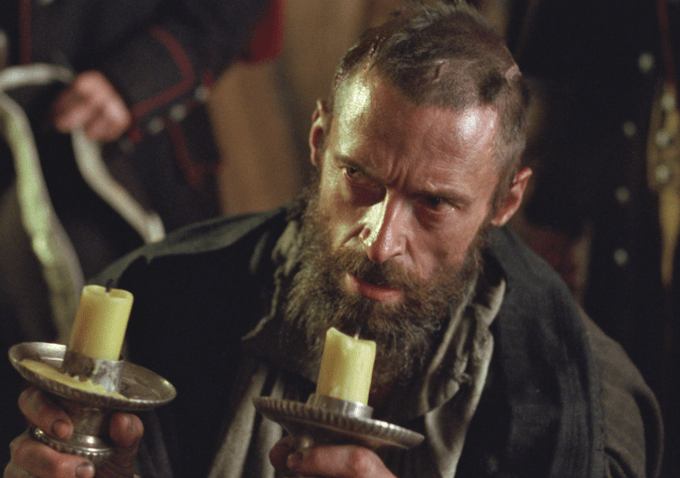
Hugh JackmanToday, I finally saw Les Misérables. Being a fan of plays and musicals, I wanted to see this film for quite some time. While I was aware of the general premise behind the film, I never read the novel or saw the musical. I’m glad to say that it was a terrific film, filled with glorious music and a stellar cast. To me, what was most interesting about the movie was that Colm Wilkinson, the original Jean Valjean, passed the torch to Hugh Jackman.

Wilkinson’s presence in the film was a smart way to pay homage to the original musical, and the message behind the scene where he handed candlesticks to Hugh Jackman’s character was clear: The torch has been passed. Wilkinson, a fixture of Broadway, lent his voice to an extensive list of musicals, including: Les Misérables, The Phantom of the Opera, Man of La Mancha, and Jekyll & Hyde, just to name a few. Now it’s Hugh Jackman’s turn. As you’ll see from the video below, this symbolic passing also took place off the screen.

For those yearning for Colm Wilkinson’s Jean Valjean, below is a video of him performing “Bring Him Home” at the Les Misérables 10th Anniversary Concert.

It’s All In The Details

I’m in the process of writing my first novel, and it’s a time-consuming endeavor because I work two jobs and I’m in graduate school. However, now that I have a new Google Chromebook, I’m starting to make some headway. Having just written a new chapter, I came to a realization about what makes a book memorable to readers – details.

Many of the most effective modern authors (e.g., Ken Follett, Lee Child, etc.) write stories that resonate with readers because they pay close attention to the details. By this I mean they take great care in making sure their stories are infused with a considerable amount of specificity. Whether it’s describing the color and texture of a piece of clothing or slowly unveiling a gripping backstory for one of the lead characters, these authors understand the value in creating a three-dimensional world that readers can practically smell, taste and touch.

With this in mind, I’m making sure my novel contains a considerable amount of detail. I want readers leave my book feeling like they have a true understanding of my characters, their motivations and where they come from. That said, I realize that it’s equally important to make sure the plot doesn’t play second fiddle to the details.

When reading a book or watching a movie or TV show, what do you enjoy most about the story? Do you find the details help flesh out the characters and the situations they face, or do you think they get in the way?

Book Excerpt: Dead End

20121227-195145.jpg

When it comes to pieces I’ve written, so far, I’ve only posted poetry to my blog. Below is the prologue to an upcoming thriller/horror book I’m writing; I call it Dead End. Enjoy!

Dead End

Tom stepped into the night, not knowing what to expect…yet a feeling of foreboding hung in the nighttime mist.

The streets were desolate and it started to drizzle. Tom’s face was flecked with small beads of water, and it felt good on his warm skin.

Seemingly out of nowhere he heard footsteps from behind, so Tom peered over his shoulder. The ominous man wore a trench coat, which hung loosely from his tall, thin frame. In his right hand his fingers were clasped around a walking stick. It was hard to see, but it appeared to have a metallic wolf’s head on top of it.

Tom didn’t know the man, but, for some reason, he instantly feared him and quickened his pace. As he did so, he heard the man’s footsteps increase in rapidity. As Tom passed shuttered businesses and abandoned houses, all he could hear was the rhythmic pounding of the man’s footsteps and walking stick.

Then, he heard nothing. Tom turned around and no one was there. He breathed a sigh of relief and stepped under a tattered awning to call for a cab from his cell phone.

A thunderclap let out and the skies opened up. In a matter of minutes Tom was drenched from head to toe in a deluge of water. His grip on the phone slipped and it hit the sidewalk with a wet, hard smack. To his dismay, it was cracked and beyond repair.

After covering so much ground, he was determined to walk home and save the money that would have been spent on the cab. Lord knows he’d now need it to replace his phone.

As he crossed the intersection and approached a side street, cold, wet hands gripped his neck and threw him to the pavement. Tom shook his head, looked up and found himself face to face with the dark figure from earlier. But this time he was in an alley with a dead end.

Tom could barely see the man through the sheets of rain. What he did see was the man’s walking stick cutting through the darkness, and what he heard – and felt – was it connecting with his skull. Tom tried to fight back, but the man kicked him in the gut and viciously brought the stick down hard on Tom’s head one last time, breaking the cane in two. Cloaked in darkness and covered in blood, he died in that alley. And all he could see before breathing his last breath was the blood-soaked wolf’s head of the walking stick, gleaming in the moonlight.