WWE, the iconic sports entertainment company that made professional wrestlers like The Rock, Hulk Hogan and “Stone Cold” Steve Austin household names, just announced WWE Network. This 24/7 streaming network, launching February 24, will provide subscribers with access to all 12 live WWE pay-per-views, including WrestleMania, as well as “original programming, reality shows, documentaries, classic matches and more than 1,500 hours of video on demand at launch.” The best part is subscribers only have to pay $9.99 a month for all this content, and it can be streamed through the WWE app on nearly every device you can think of (i.e., desktop/laptop computers, iOS and Android devices, Kindle Fire tablets, Roku, Xbox 360/Xbox One, Playstation 3/4, etc.).
What has me most excited about this news isn’t that I’ll be able to access every WWE, WCW and ECW pay-per-view ever – although that is awesome – it’s that this service doesn’t require me to have an existing relationship with a cable provider like HBO GO does. WWE is the first cable content provider to cut out the middle man and provide its product directly to consumers through a paid streaming service. And unlike Netflix and Hulu Plus, WWE doesn’t need to pay movie studios large amounts of money to lease this content because they already own it. For WWE, this will be a huge revenue stream for the company and a smart way to provide pay-per-view content to fans at an extremely attractive price.
Needless to say, I’m very impressed by this announcement and excited to try out WWE Network on February 24. Check out the videos below for a taste of what’s to come.
My musical tastes are eclectic – I like everything from Patti LaBelle to Chromeo. Regardless of musical genre, I’m a sucker for a good melody and a great lyric. “This Train Still Runs” by Janis Ian has both. My favorite part of the song is:
“Sure as a baby loves the teat
Sure as a high heel on concrete
Sure as the songs I’ve left unsung
This train still runs”
And my favorite line is “sure as a high heel on concrete” because it’s incredibly visual without being overly descriptive.
Below are the rest of the lyrics and a live recording of the song. Enjoy!
This Train Still Runs
Janis Ian/Jess Leary
“I felt a rumble in my heart, over the mountains
as the engine ate the spark, spitting out the miles
Times when I tried to jump the track
Weight of the world upon my back
Still after all is said and done
This train still runs
It doesn’t matter where it’s gone
This train still runs
and though the baggage weighs a ton,
we carry on
Nothing is forever young
I’m not done – this train still runs
I had a friend I left behind, back at the station
We used to burn the power lines, racing with the wind
But time has the manners of a thief
Young love turns bittersweet
Still we keep that lantern hung – this train still runs
This train still runs
It doesn’t matter where it’s gone
This train still runs
and though the baggage weighs a ton,
we carry on
No one is forever young
I’m not done – this train still runs
Got a ticket in my pocket & I’m ready to ride
Got a motor rolling over to an easy glide
I’m gonna travel on the gravel to the other side
Sure as a baby loves the teat
Sure as a high heel on concrete
Sure as the songs I’ve left unsung
This train still runs
This train still runs
It doesn’t matter where it’s gone
This train still runs
and though the baggage weighs a ton,
we carry on
Nothing is forever young
I’m not done – this train still runs
This train still runs
This train still runs”
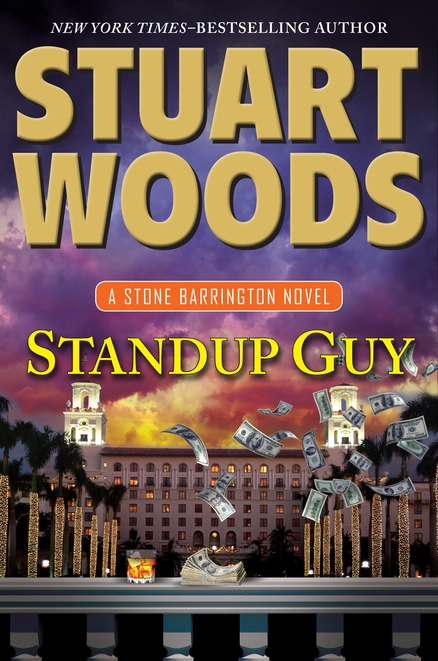
Stuart Woods is one of the first thriller writers whose work I fell in love with. His characters have fantastic names like Felicity Devonshire, Vance Calder and, my all-time favorite, Stone Barrington. I’m constantly impressed by the fluidity of his prose, as well as his wonderfully descriptive romantic scenes. There have been countless occasions when I stopped reading one of his books to recite a passage to a friend because I was so impressed by the use of adjectives, verbs and metaphors. Simply stated, he’s a terrific writer everyone should read. Speaking of which, Stuart Woods has a new Stone Barrington novel available: Standup Guy. Make sure to pick up a copy after reading my interview with the author below.
After graduating college, you started out working at several advertising agencies. What made you realize advertising wasn’t for you, and how did your time in the industry influence your future writing?
I found the advertising business to be a wonderful preparation for writing professionally. I always advise young people who want to write for a living to find a job in advertising, journalism, PR – any profession that requires you to sit down and write a thousand words a day, whether you feel like it or not. Advertising did that for me, and in addition, I had to satisfy some very demanding bosses – some of the best writers in the business – who wanted persuasive writing and every word to count. I left because I felt I had gone as far as I was going to go in that business, and because I had wanted to write fiction since I was a child, and leaving advertising forced me to finally write the novel I had been thinking about since I was ten.
Your first novel, Chiefs, earned you an Edgar Award. How did it feel to be honored by your peers for your first novel?
I didn’t know the Mystery Writers of America were my peers, since I had never heard of the award, though I was very happy to receive it. I thought I had written a novel about how small towns worked, but I was delighted that they found it to be mysterious.
Chiefs was turned into a TV miniseries with a stellar cast of actors, including Charlton Heston, Danny Glover, Billy Dee Williams, and John Goodman. Did you have an active role in the creation of the miniseries, and did it live up to your expectations?
I didn’t write the screenplay, but the producers were kind enough (and smart enough) to send me every draft of the screenplay and solicit my comments and suggestions. I made a lot of those, and they even accepted some of them, particularly in casting. Heston’s character, Hugh Holmes was based on James S. Peters, a father of my home town, and I interviewed him at length about the town’s history. I loaned the tapes of that interview to Heston, and he used them to create his character and his accent. I was delighted with the miniseries; I thought it true to both the plot of the novel and its intent. I played a small part in the mini-series, and they made me travel to New York to read for it. I had a two-minute scene with Billy Dee Williams, a fine actor who, for some reason, could not remember his lines. We rehearsed at length, shot it, then rehearsed some more and shot it a couple of more times. He finally got his lines right, whereas I was perfect throughout. I thought, “This acting thing isn’t so tough; after all I knew my lines.” Then I saw the series at a screening: Billy Dee was wonderful, and I came off as a blithering idiot. I thought, “Maybe there’s something to this acting thing, after all.”
I thought your standalone thriller, Under the Lake, was one of your best. It’s very different from your other work but just as captivating. It even attracted the attention of Stephen King, who lauded the book by saying, “it scared the living hell” out of him. More than 25 years later, what’s your opinion on the novel?
I reread it when someone was writing a screenplay (ultimately unproduced) from it, and I liked it a lot. I tried to get Simon & Schuster to use King’s comment, which was one line in a fulsome letter he wrote about the book, and they wouldn’t. They wanted to say, “It scared the living heck out of me.” (!)
For the past several years you’ve been providing fans with a steady flow of Stone Barrington novels. Do you plan on revisiting any of your other series or writing any new standalone thrillers?
My publisher persuaded me to write only Stone novels in a new contract (he offered me money, and I can be bought). I think he meant that he wanted the words, “A Stone Barrington Novel” on every cover. I tricked him by including all the other series characters in the various novels. Anyway, my readers who write to me like Stone best.
Having written 28 Stone Barrington novels, how do you keep your books fresh?
I have a fevered imagination and a rich fantasy life, which helps with the sex scenes.
Your memoir about sailing, Blue Water, Green Skipper, was re-released in 2012. How did the fans of your thrillers respond to Blue Water, Green Skipper when it was, once again, made available to the public?
I’ve had a great deal of mail about the book from readers – most of them, yachtsmen, and they were all warm in their praise. Reading it allowed me to revisit a happy time in my life. One day, I’ll write a full-blown autobiography, and I’ve reserved the right to plug the old book into the new one. I don’t think I can write about that time of my life any better.
Many popular writers, including James Patterson, have increased their productivity by collaborating with other authors on novels. Some readers don’t care for this practice because they feel having a co-author dilutes the end product, while others are perfectly fine with it. What’s your opinion on the matter, and would you ever collaborate with another author on a book?
I’ve never done that, though my publisher says he would like it. I’ve instructed my widow-to-be to call my agent as soon as I’m dead and hire a few writers, and I’ve explained to her that Jim Patterson makes more money than God.
Since you’re working on and releasing multiple books a year, how do you go about keeping track of all the characters and details from novel to novel?
My characters exist for me in an alternate universe; I know exactly what’s happened to them, though they know nothing about me. Apparently, they don’t read. I seem to have a gift for keeping their stories in memory.
What are you working on now and what’s next for Stone Barrington? There are two Stone novels completed and awaiting publication, and I’ll finish another this week. Standup Guy is coming out on January 7th.
I recently finished Steven James’ latest novel, Singularity, the sequel to a book I enjoyed quite a bit, Placebo. So, how does this measure up to the last one in the Jevin Banks series? I’d say it’s just as good, if not a little better, than Placebo.
Having already become acquainted with these characters, I was happy to see them grow and mature in Singularity. As a matter of fact, I’d say character interaction and development is what James does best. While the sometimes-too-long scientific descriptions took me out of the story, the terrific dialogue, humor and dash of romance made up for it. Similar to Harlan Coben’s Myron Bolitar and his sidekick Win, James has an equally compelling dynamic duo with Jevin and Xavier. And the supporting cast is wonderfully nuanced and intriguing, especially Fiona and her brilliant children.
Other than the copious amount of scientific information, the only other detractor for me from the story was the amount of sub-plots. Several times in every chapter there are breaks and the reader is transported to a different storyline. I understand that this was done because the storylines eventually overlap, but if you don’t plan on finishing the book in a sitting or two, or if you stop in mid-chapter, it might take you several pages to remember what happened last and what’s happening at that given moment. To me, I really only cared about the main cast of characters, not the tertiary ones, so I think keeping only one subplot would have made for a cleaner read.
Regardless of my stylistic quibbles, Singularityis a solid novel that tells a compelling story featuring charming characters whom I’ve grown to like even more than I did after reading Placebo. If you’re not sure what to read next, give this book a shot. It’ll keep you engaged from start to finish and whet your appetite for the next installment in this promising series.
When his friend is murdered, illusionist Jevin Banks is determined to find out what really happened. Drawn into a web of conspiracy and top-secret research on human consciousness, Jevin won’t stop digging until the truth is revealed. Soon he uncovers a dark secret–one that could change the very fabric of human life on the planet.
2013 was my first full year of blogging, and it was a great one. I wrote 174 posts and exceeded 20,000 views, reaching people in 118 countries. I also had the honor and privilege of interviewing some of my favorite authors, actors and musicians, including:
And 2014 is shaping up to be an even bigger year with interviews already scheduled with 2014 Rock & Roll Hall of Fame Inductee John Oates and bestselling author Stuart Woods.
Thanks to all of you who regularly read my posts, as well as those who take the time to comment. Speaking of which, below are my top commenters’ great blogs. Make sure to check them out:
Today, I started and finished one of the shortest – and best – video games I’ve ever played: Gone Home. This game, developed by The Fullbright Company, is unlike most video games in that you won’t be leveling up, wielding a gun or jumping from platform to platform. Instead, you’ll find yourself wandering through a dimly lit house unraveling an emotionally stirring story about a young girl’s family. Set in 1995, the house is filled with VHS tapes, fanzines and records, as well as other vestiges of this time period.
In addition to the items strewn throughout the house, the story is told through answering machine messages, handwritten notes, photos, postcards, and countless other items you’d expect to find in a dwelling such as this. The bulk of the unpredictable story comes to life through the superb voice work of Sarah Grayson, who plays the role of Samantha Greenbriar. The smartly written script, along with Grayson’s excellent performance, make for a compelling narrative that keeps you on the edge of your seat wondering what’s next.
Also worth noting is the wonderful score composed by Chris Remo. While a good portion of Gone Home includes records and cassettes featuring licensed music, Remo’s haunting score perfectly sets the tone for the game and enhances the dialogue at exactly the right moments. It’s the best video game soundtrack I’ve heard since Petri Alanko’s score for Alan Wake. I wholeheartedly suggest you pick up a copy of Remo’s original score here.
While it can be completed in two hours, Gone Home is an unconventional game that immerses the player in an unpredictable and thoroughly entertaining story that’s worth playing again. Even better, the game now features a commentary mode where, while playing the game, you can learn more about the creative process and all the hard work that went into constructing this masterpiece.
Gone Home is one of the best games of the year for two reasons: it tells a great story and it does so in a way that goes against the grain. If you’re a fan of video games, or great stories, I highly recommend you buy this game. It’s an unforgettable experience that shows how video games, when done right, can be unparalleled works of art.
It’s hard to believe but I read 54 books in 2013. Since I love books in all forms, this includes audiobooks, print books and e-books. You can check out the full list of what I read here. Below are a few of my favorite books, categorized by genre, that I read this year.
If you’re thinking about buying the Alienware Vindicator backpack, make sure to watch my video review below first. The good news is Dell is sending me a replacement backpack at no charge, so we’ll see how that one holds up:
Anchorman 2: The Legend Continues, the sequel to the 2004 comedy Anchorman: The Legend of Ron Burgundy, opened this weekend following what I consider to be one of the most creative advertising campaigns ever for a feature film. The question is, does this sequel live up to the hype? Read on my curious friend.
Unlike the first film, which was set in the 1970s, Anchorman 2 takes place in the 1980s – my favorite decade! Despite the questionable fashion choices in this decade of decadence, the music, movies and TV shows were awesome. Speaking of which, Anchorman 2 has a killer soundtrack. You’ll find everything from John Waite’s “Change” to Neil Diamond’s “Shilo” to “Every 1’s a Winner” by Hot Chocolate. And the obligatory Kenny Loggins’ track is on here too – the terrific “This Is It” featuring backing vocals by Michael McDonald. It’s a feast for the ears that compliments the movie’s visuals perfectly.
While the classic one-liners from Anchorman: The Legend of Ron Burgundy are a tough act to follow, Anchorman 2 does its best to deliver the goods. As a fan of the first film and Will Ferrell, I’m glad to report that the majority of this movie delivers the goods. However, it does drag on longer than it should and it felt as though the plot lacked focus toward the end.
The bottom line is this – if you didn’t see the first movie or don’t like Will Ferrell’s brand of humor, don’t bother seeing Anchorman 2. On the other hand, if you love the first film and can’t get enough of Will Ferrell, give this one a shot. It’s not as good as the first, but it features excellent music, solid performances across the board, countless cameos by Hollywood A-listers, and, most importantly, gut-wrenchingly funny moments.
I recently had the opportunity to interview the Grammy award-winning artist Melissa Manchester. Known for her signature sound and countless hits, including “Midnight Blue,” “Don’t Cry Out Loud” and “You Should Hear How She Talks About You,” Manchester has been an icon in the music industry for more than 40 years.
I’m attending Melissa’s concert in New York City on February 16, and it should be a fabulous Valentine’s Day weekend performance. If you’re interested in attending this show or another one of her concerts, make sure to visit the tour page on her website.
It was a delight speaking with Melissa, and I hope you enjoy the interview below.
For your upcoming studio album, You Gotta Love The Life, you used Indiegogo to include your fans in the process and wound up raising more than $40,000. Were you happy with the experience, and how was it received by your fans?
It was a mind-blowing experience. It was my students – I teach at USC, at the Thorton School of Music – it was my students that awakened me to this new definition of the marketplace. They helped lead the team and do the project management. I said yes. It was fascinating because my fans are so interested in the process, actually, almost as interested in the process as I am; and because I was doing so many Facebook entries and all that, it was so sweet, and started to become this living, breathing entity. And when the campaign was over (laughs), the fans said “please don’t stop posting, it’s so wonderful to read what you have to say.” I would do it again in a heartbeat. I just thought it was fascinating.
Now that the Indiegogo campaign is over, what’s the next step for your new album?
Well, the album is half-recorded and I’m going back into the studio in January to finish it and orchestrate it, and mix it, and master it, and all that. Hopefully it will come out either this spring or this fall, definitely one of the two.
You’re releasing this on your own, directly to the fans, correct?
At the moment I am, and if fans go onto my website the first single is free to download as a thank you gift to them. It’s a rethinking of the classic “Be My Baby,” which I didn’t realize, this year, is 50 years old. So, it’s a lovely way to celebrate that song.
My favorite song by you is “Don’t Cry Out Loud.” In Clive Davis’ recent autobiography, The Soundtrack of My Life, he said that originally you weren’t in love with the idea of singing the song. What’s the story behind that?
Well, I believe that Mr. Davis, like many of us, has selective memory, and that’s fine. I loved the song the way my friend Peter Allen first presented it, which was very quiet and very intimate. Clive Davis’ version was this big anthem, and at the time it turned out splendidly, and I’m grateful for that. Clive and I had a lot of success and (laughs) a lot of failure together.
It’s interesting that you mention it originally being a softer song because now when you sing it live it’s usually a more stripped down version. Is that how you originally imagined it?
When I’m doing my duo show with myself and Stephan Oberoff, my keyboard player, we do a very quiet version and it really makes the crowd go crazy because they’re inside the song like I am. And when we’re with a symphony or my larger band, it’s the larger more well-known version and everyone is delighted to hear that as well.
That’s nice that you can have such flexibility with the song.
That’s the magic of live performance. You can reinterpret things on the spot – it’s fantastic.
Speaking of live performances, I’m attending your concert on February 16 in New York City. Do you have any new material from your upcoming album that you’re going to try out on the hometown crowd?
Sure, there’s plenty of new stuff from the album that will be all over the stage, and because of the occasion of Valentine’s Day, you never know what I might sing.
While at NYU, you were enrolled in a songwriting class taught by Paul Simon. Today, you’re an Adjunct Professor at the Thorton School of Music. What’s a typical semester like for someone enrolled in your course?
Well, I teach a class I call “The Art of Conversational Singing.” I teach mostly the pop students and some musical theater kids, and they bring in whatever they want to learn about that day. Sometimes we discuss their compositions, and sometimes they want to talk about the life on the road – surviving that. I always assign them songs from the first volume of the American Songbook because I want them to see what singing was like, what breathing was like when songs were melody driven, as opposed to rhythm driven, which is the aesthetic of today. And it’s all very interesting because there’s no way they can imagine what a career feels like in the bones but I can absolutely reimagine what it feels like to be at the beginning of that adventure. So, what I’m trying to do is help them survive it as intact as possible.
That must be interesting for you now being the teacher when you were previously the student. I imagine it’s a surreal experience.
(laughs) It is surreal. Totally surreal, that’s the word.
You and Barry Manilow, who I adore, met while singing jingles for commercials, and you both identify as singer-songwriters. Is this one of the reasons that your friendship has remained so strong over the years?
Well, we really grew up together. And because we shared the experience of Clive Davis together, we really (laughs) know what that kind of experience is all about. We have enormous respect for each other, and surviving in this industry, relatively sanely, relatively stably, relatively well is no small feat because, as you well know, the industry is littered with cliches of people who were enormously talented that couldn’t chew gum and walk at the same time. So, to have been gifted with this long career that shows no end in sight, is something we share and our enormous respect for each other.
Our idols were the singers that did have very long careers: Ella Fitzgerald, Judy Garland, Rosemary Clooney, and Tony Bennett. Those people were our touchstones of the kind of long careers we were looking for. We were never really rock and rollers, so it’s sort of interesting that I’m number 92 on the list of top 100 rock and roll females (laughs).
We’re very loving friends, and part of the goal of my Indiegogo campaign was to donate a portion of the funds to the Manilow Music Project, which I think is just a fantastic organization. He has his fans donate used musical instruments and he has them repaired and donates them to public schools.
You’re currently co-writing a new musical, The Sweet Potato Queens. What’s the premise behind it and when should fans expect to see it on stage?
It’s a little too early to talk about it other than that I’m writing it with Rupert Holmes and Sharon Vaughn, and we’re just starting to present it for workshop.
You’ve been in movies, plays and, of course, Blossom. How is acting on stage different than being on screen? Do you prefer one over the other?
Acting is sort of scary business. With singing you always have the energy of the music to inform you, regardless of how you’re feeling or what you’re going through in your personal life. Whereas, with acting there’s nothing but you and the silence, so you better be really present and in that moment. But all creative energy has room for all versions of expression. Whether I’m writing a score for a Disney movie, or writing a song for my upcoming album or writing a show, it’s all coming out of the same hunger. I’m really still as hungry to create as when I first started.
You were nominated for two Grammy awards before winning the 1982 Grammy for Best Female Vocalist. How did it feel to win the big one?
It was delightful, of course, but it was certainly surprising because prior to that I was nominated for those mid-tempo ballads that I was (laughs) sort of known for. So, to be nominated for “You Should Hear How She Talks About You,” which was this great disco record that the great Arif Mardin produced for me was so surprising but so delightful. At first, I couldn’t quite get it and sync up with it. I couldn’t totally accept the gift that I’d been given by my friends Tom Snow and Dean Pitchford, who wrote it for me. Now when I sing it live, I always show the videos of me performing it on Solid Gold and on the Grammys, and it’s lovely to be able to chuckle along with the audience about the shoulder pads and my hair cut (laughs) and all that stuff. And the song is great, it’s just great. I’ve been very fortunate to have lots of great songs cross my path.
Your father was a bassoonist with the Metropolitan Opera. How did his career affect your own?
There was always music around the house. My Mother was a wonderful singer. And my Father sometimes would take me to the opera with him to dress rehearsal when I was very very little. The grandness of it was very normal for me, the big vocal sound was very normal for me. The long held notes, the expressive interpretation – that was just the way music was supposed to be sung, and it was validated by all of the popular singers: Ella and Judy and Rosie and Sinatra and Tony Bennett and Nat Cole, and all of those people. It was all part of a continuum. It’s what really informed me.
Those are great performers to grow up with and experience. Much better than what we have today.
Well, I think so. That’s why I assign my students songs from the first volume of the American Songbook. I want to make sure they understand that the music form started with Stephen Foster and that what they hear today is only the latest version, and that the there was an earlier version that was melody driven and not rhythm driven. The lyric writing and the melodic structure – that’s something they need to feel and dig into to help not only bring it forward but to also bring it into their composition.
You were one of Bette Midler’s original Harlettes. How was it working with the Divine Miss M?
She was sensational. She’s a truly brilliant woman, and as she says, she has the soul of a librarian (laughs). I was fortunate to work with her at the very beginning of her career. I worked with her for six months, right after she had been on the Johnny Carson show for the first time. To be part of watching that ascendancy from an interesting and unique vantage point, which was to the left of her as the toots in the middle, was fantastic because she gave a voice to the gay audience, which had been marginalized up to that point. She galvanized their culture and population through her energy and focus, and her choice of material was superb. Her vision on stage was superb. It was a magnificent experience.
I saw Rod Stewart earlier this week and he was fabulous as always. And, at one point in the show, he brought out his daughter, Ruby, to sing a couple songs. Do your children share your musical talent?
My son is talented but he’s more of a shower hummer (laughs). My daughter and I sometimes sing on stage and it’s lovely because there’s a tone in her voice that is from me – it’s my gene pool – and yet she has her own smokey, jazzy voice. She’s sort of a throwback like me. She likes those standards, and those long lines to sing. So, yes, we have sung together.
Aside from the classic singers you previously mentioned, who are some of your favorite performers to listen to?
I like Radiohead, Sarah McLachlan and Bonnie Raitt is a giant to me. I love Beyonce, I think she’s remarkable. And I love Katy Perry. I think she writes fantastic anthems.
Since you mentioned Beyonce, what are your thoughts on her secretly releasing her new album on iTunes?
I think the marketplace is open for absolutely anything anybody can imagine. I heard that we are now in a frictionless industry, which means you don’t have to necessarily bend to the convention. If you can think of a new way to do it, it may just work.
That’s true. Today, the delivery of content, whether it’s digital music or e-books, is much more direct. Speaking of which, you recently streamed a concert online from your studio for your fans to watch. For those that missed it, will it be available to view on your YouTube channel at a later date?
No, when you do it on StageIt.com it’s just a half hour or 45 minutes and it’s gone. So, when people jump on, it’s just a lovely communal experience and that’s it.
It sounds like it went well. Would you consider doing it again?
Oh, I’m gonna do it again.
Are there any other exciting projects you’re working on that you’d like your fans to be aware of?
I’m starting rehearsals today for the Colors of Christmas tour that starts tomorrow in Cerritos and goes across the country for nine days, and it’s kind of wild and fast, and I’ll be home by Christmas Eve. But between now and then, I’m gone.

 WWE, the iconic sports entertainment company that made professional wrestlers like The Rock, Hulk Hogan and “Stone Cold” Steve Austin household names, just announced WWE Network. This 24/7 streaming network, launching February 24, will provide subscribers with access to all 12 live WWE pay-per-views, including WrestleMania, as well as “original programming, reality shows, documentaries, classic matches and more than 1,500 hours of video on demand at launch.” The best part is subscribers only have to pay $9.99 a month for all this content, and it can be streamed through the WWE app on nearly every device you can think of (i.e., desktop/laptop computers, iOS and Android devices, Kindle Fire tablets, Roku, Xbox 360/Xbox One, Playstation 3/4, etc.).